
PUBLISHED: CONSREV, VOL. 4, NO. 2 (December 2018)
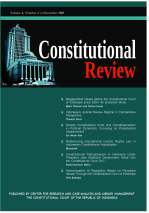
Constitutional Review (CONSREV) is an international journal published by the Center for Research and Case Analysis and Library Management of the Constitutional Court of Indonesia. The fundamental aim of this journal is to disseminate research and conceptual analysis which focus on constitutional issues.
In the last edition of Year 2018, six articles are presented by constitutional law scholars from various universities and institutions, as follows:
- “Megapolitical Cases before the Constitutional Court of Indonesia since 2004: An Empirical Study” by Associate Professor Björn Dressel (Australian National University) and Professor Tomoo Inoue (Seikei University). DOI: https://doi.org/10.31078/consrev421.
- “Indonesia’s Judicial Review Regime in Comparative Perspective” by Professor Theunis Roux (University of New South Wales). DOI: https://doi.org/10.31078/consrev422.
- “Korean Constitutional Court and Constitutionalism in Political Dynamics: Focusing on Presidential Impeachment” by Jin Wook Kim (The Constitutional Court of Korea). DOI: https://doi.org/10.31078/consrev423.
- “Referencing International Human Rights Law in Indonesian Constitutional Adjudication” by Bisariyadi (The Constitutional Court of Indonesia). DOI: https://doi.org/10.31078/consrev424.
- “Constitutional Retrogression in Indonesia Under President Joko Widodo’s Government: What Can the Constitutional Court Do?” by Abdurrachman Satrio (University of Padjadjaran). DOI: https://doi.org/10.31078/consrev425.
- “Harmonization of Regulation Based on Pancasila Values Through the Constitutional Court of Indonesia” by Tedi Sudrajat (Jenderal Soedirman University). DOI: https://doi.org/10.31078/consrev426.
The Editors expect that this issue might give some new insight and understanding on recent developments on constitutional law and constitutional courts in broader nature to our readers. The full issue of this edition can also be downloaded here: https://bit.ly/2U7sqIQ. Please feel free to share this journal with others.
Best regards,
Pan Mohamad Faiz, Ph.D.
Editor-in-Chief
 Constitutional Review (CONSREV) is an international law journal published by Center for Research and Case Analysis and Library Management of the Constitutional Court of the Republic of Indonesia. The fundamental aim of this journal is to disseminate research, conceptual analysis, and other writings which focus on constitutional issues.
 Abstract: Indonesia implements dualism of judicial review system because there are two different judicial institutions that are granted the authority to review laws and regulations, namely the Constitutional Court and the Supreme Court. This research aims to analyse the problems caused by the dualism of judicial review system. It found two main legal problems of the current system. First, there is an inconsistency of decisions concerning judicial review cases for the same legal issues decided by the Constitutional Court and the Supreme Court. Second, there is no mechanism to review the constitutionality of People’s Consultative Assembly (MPR) decisions and regulations under the level of law. Based on these findings, this research suggests that the authority to review all laws and regulations should be integrated under the jurisdiction of the Constitutional Court.
 Abstract: The judicial appointment process is one of essential elements for maintaining judicial independence and public confidence of a court. This article analyses the practices of judicial appointment process exercised by three different main state institutions in selecting constitutional justice in Indonesia where the mechanism and process for selecting them have been implemented differently. It also examines the tenure of constitutional justice, which is a five-year term and can be renewed for one term only, that may lead to another problem concerning the reselection process of incumbent constitutional justices for their second term. The article concludes that the judicial appointment process and tenure of constitutional justice in Indonesia have to be improved. It suggests that if the proposing state institutions could not meet the principles of transparency, participation, objective and accountable required by the Constitutional Court Law, the judicial appointment process should be conducted by creating an independent Selection Committee or establishing a cooperation with the Judicial Commission. Additionally, the tenure of constitutional justices should also be revised for a unrenewable term with a longer period of nine or twelve years.
 Pan Mohamad Faiz, S.H., M.C.L., Ph.D.